
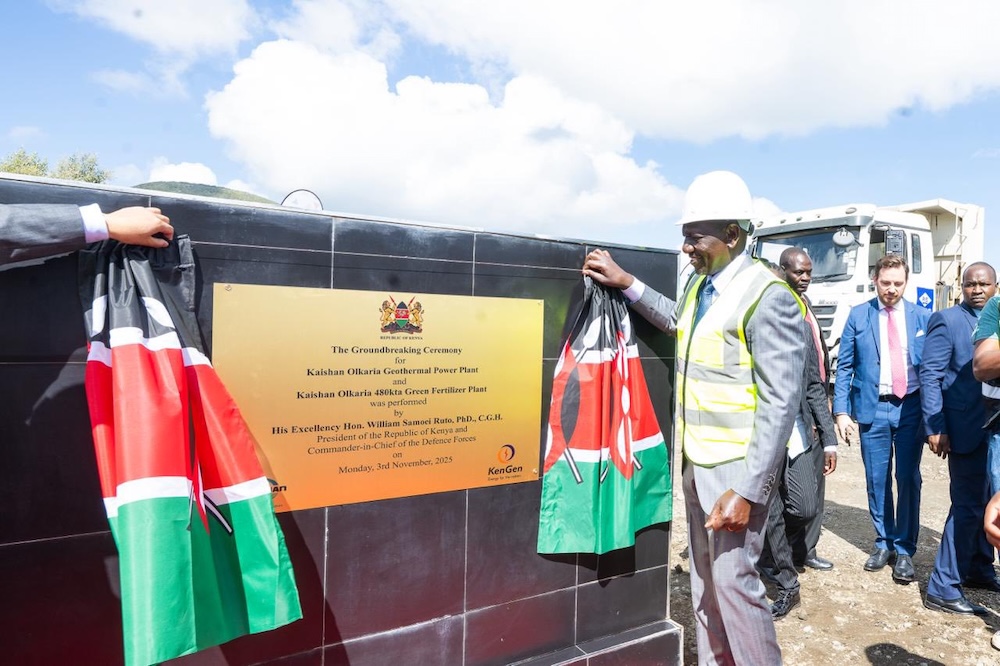
Kenya Breaks Ground on $800M Geothermal-Powered Fertiliser Plant

In a landmark move to bolster food security and reduce reliance on costly imports, Kenya has officially broken ground on a massive $800 million (Sh103 billion) fertiliser plant that will be powered entirely by geothermal energy.
President William Ruto, presiding over the groundbreaking ceremony in Olkaria, Naivasha, on Monday, November 3, 2025, hailed the project as a revolutionary step toward agricultural self-sufficiency and green industrialisation.
The facility, a joint venture between the Kenya Electricity Generating Company (KenGen) and the Kaishan Group of China, will be the first of its kind in Africa. It aims to directly tackle Kenya’s dependence on volatile global fertiliser markets, which saw the country spend nearly Sh60 billion on imports in the first half of 2025 alone.
“For decades, our farmers… have borne the burden of unpredictable fertilizer prices, supply shocks and global volatility,” President Ruto stated at the ceremony. “Today’s event marks a decisive step toward self-sufficiency and resilience in fertiliser production.”
Unlike conventional fertiliser production, which is heavily reliant on natural gas, the Olkaria plant will use a uniquely sustainable process. KenGen will supply 165 megawatts (MW) of geothermal steam and electricity directly from its Olkaria fields. This clean, renewable energy will power a large-scale electrolysis process, which splits water (H₂O) into hydrogen and oxygen. Because the electricity is from a green source, the resulting product is known as “green hydrogen.” This green hydrogen is then synthesized with nitrogen drawn from the air to create green ammonia (NH3), the primary building block for nitrogen-based fertilisers.
Furthermore, the plant’s developers, Kaishan Terra Green Ammonia Ltd., noted the facility will also capture non-condensable gases, like CO2, released from the geothermal wells. This prevents them from entering the atmosphere and creates a “zero emissions” process, projected to prevent more than 600,000 tonnes of carbon dioxide emissions annually.
The plant is a cornerstone of the government’s Bottom-Up Economic Transformation Agenda (BETA), which prioritises food security. With a projected annual production capacity of 480,000 tonnes, the facility will produce key varieties like Calcium Ammonium Nitrate (CAN) and Green Urea. This output will significantly offset the more than 600,000 tonnes Kenya imported in 2023.
By creating a stable, domestic supply, the government aims to permanently lower and stabilise fertiliser prices for farmers, insulating them from the global shocks that have previously derailed planting seasons. The project is also a major economic driver, expected to create over 2,000 direct and indirect jobs during its construction and operation. KenGen, as a key partner, projects it will earn over $13 million (Sh1.7 billion) in annual net profits from the venture.
Construction is slated to begin in April 2026, with the plant projected to be fully operational by August 2026, marking a new era for Kenyan agriculture and renewable energy.