
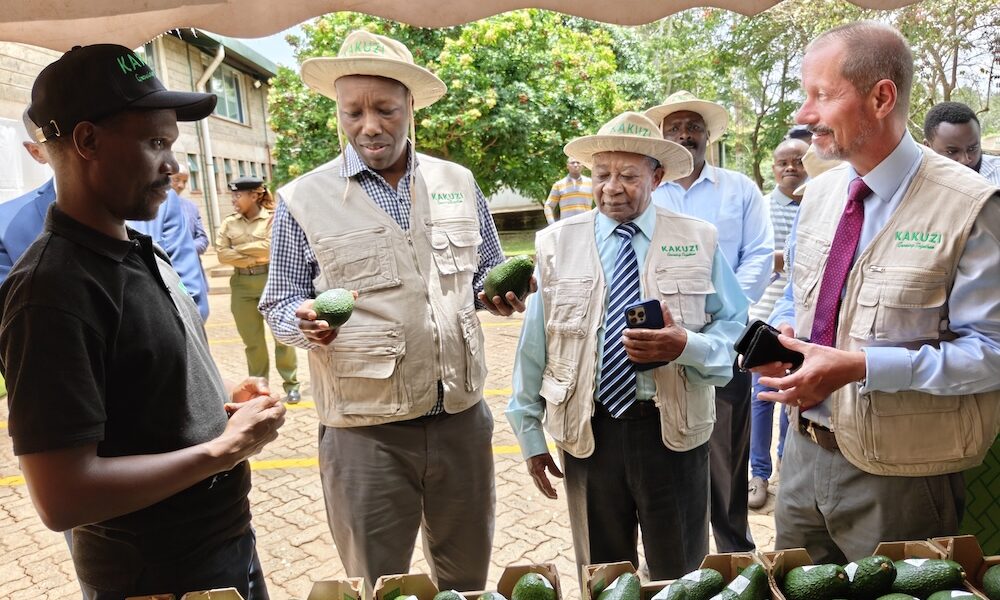

The government has reaffirmed its commitment to deepening value addition in agriculture and reducing the country’s heavy reliance on imported goods, with Investments, Trade and Industry Cabinet Secretary Lee Kinyanjui citing listed agribusiness firm Kakuzi Plc as a model for the kind of transformation Kenya needs.
Speaking during a visit to Kakuzi’s orchards in Murang’a County, CS Kinyanjui said ongoing government plans are targeting key crops and superfoods, including Macadamia, Avocado, and Livestock products, as part of a broader national industrial development strategy anchored in value addition and agro-business capacity building.
Kenya currently spends upwards of KSh 500 billion annually importing agricultural products, among them edible oils that the CS said can and should be produced locally. “As a strategic policy, the government is clear, President William Ruto is spearheading efforts to power agro-industrialisation,” he said, pointing to Special Economic Zones (SEZs), Export Processing Zones (EPZs), and County Aggregation and Industrial Parks as key vehicles for transforming raw agricultural produce into high-value goods for domestic, regional, and global markets.
Kakuzi, Kenya’s largest avocado producer and the country’s largest single macadamia orchard estate, is positioning itself at the centre of this agenda. The company is targeting more than US$100 million in annual export capacity in the medium term and has this year earmarked over US$15 million to expand its blueberry venture from 10 to 100 hectares.
CS Kinyanjui expressed particular admiration for Kakuzi’s integrated Macadamia Processing Plant, which has an installed capacity of 2,000 tons of saleable kernel and currently produces 1,000 litres of cold-pressed macadamia oil daily, one of the largest such operations in the country.
“I am impressed at the diverse manufacturing and agribusiness value addition that Kakuzi is undertaking,” the CS said. “Demand for food will always be there, even in difficult times. As they expand, they also create employment opportunities.”
He added that the government would continue backing exporters as it opens up new international markets through economic partnership agreements, while also ensuring sufficient local production to meet growing demand.
Kakuzi Managing Director Chris Flowers said the firm’s growth strategy is firmly rooted in developing high-quality consumer products for both local and export markets. “Kenya is ideally placed geographically to be Africa’s largest producer of superfoods, supplying the Far East, the Middle East, Europe, and the USA,” he said.
Beyond macadamia, Kakuzi has in recent years brought several consumer products to market, including ready-to-eat macadamia, cold-pressed macadamia oil, blueberry products, and, earlier this year, a quality loose-leaf tea brand in 250g and 500g packs. The products are available at selected retail outlets, the Kakuzi Farm Market along the Nairobi–Nyeri Highway, and through the company’s online shop.