I&M Bank and Sweden Unlock KES 3.9 Billion for Kenya’s Green Sector — Here’s What’s Actually on Offer
A Swedish government guarantee halves the bank's lending risk. For Kenya's e-mobility and clean energy businesses, that matters more than the headline number — and you can apply today.
If you run a solar installation company, operate electric motorcycles for last-mile logistics, or are building a green-certified facility in Nairobi, Kenyan banks have historically been a difficult conversation. The risk profile of climate-technology businesses — early-stage revenue, unfamiliar collateral, long payback periods — doesn’t fit neatly into traditional credit models. That dynamic is now being directly challenged.
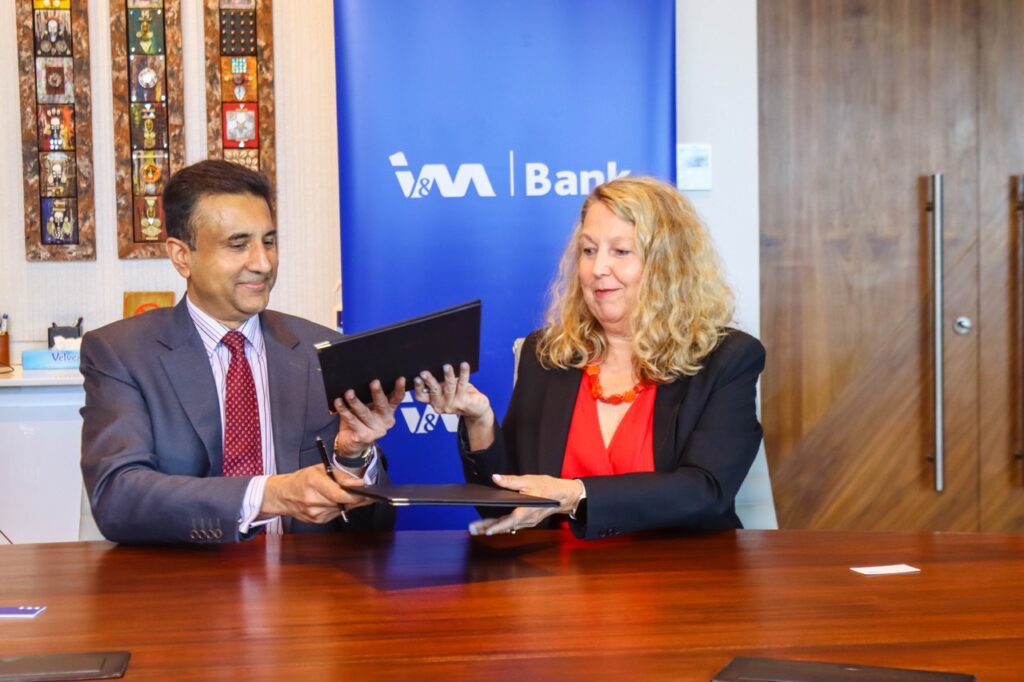
On 18 March 2026, I&M Bank formalised a Green Finance Risk-Sharing Guarantee partnership with the Swedish International Development Cooperation Agency (Sida), unlocking a dedicated green lending portfolio of up to USD 30 million — roughly KES 3.9 billion at current exchange rates. The money is earmarked specifically for businesses operating in Kenya’s green economy. We asked the bank three questions that the announcement didn’t answer. Here is what they told us.
How the deal works
The headline figure is USD 30 million, but the mechanism behind it is what makes this worth paying attention to. Sida is not handing cash directly to businesses. Instead, it is providing a USD 15 million guarantee to I&M Bank, covering 50% of the risk on eligible green loans for a period of eight years.
In practical terms: if I&M Bank lends KES 50 million to a clean transport company and that loan defaults, Sida absorbs half the loss. That guarantee removes a significant barrier. Banks are not reluctant to lend to green businesses because they disbelieve in the sector — they are reluctant because novel business models carry risks that standard credit scoring tools were never built to assess. By underwriting half of that uncertainty, Sida gives I&M Bank the confidence to say yes to deals it might otherwise decline. The USD 15 million guarantee levers up to USD 30 million in total lending — a 2x multiplier of public development money into private capital.
Can early-stage startups actually access this?
This was the most pressing question for electric.ke’s readership, and the bank’s answer is cautiously encouraging. Shameer Patel, I&M Bank’s Director of Retail and Business Banking, confirmed that e-mobility is explicitly included within the eligible green finance categories. On startups more broadly, he was direct: “Each startup is defined differently in terms of its own unique risk profile and level of operationalisation. We therefore encourage startups to visit the bank and work with our Relationship Managers through their financing requests as it would be looked into case by case.”
That answer is honest. There is no fixed minimum ticket size or dedicated startup window within the facility — what exists is a commitment to evaluate each business on its own terms rather than running it through a one-size-fits-all corporate credit filter. For a first-year e-motorcycle fleet operator that looks nothing like a legacy SME borrower, that case-by-case approach is arguably better than a rigid product that may not accommodate their structure. It also means preparation matters: walk into that branch conversation with your financials, your business model, and a clear articulation of the green use of funds.
What the vetting process actually looks like
Green finance labels can be cosmetic. We asked I&M Bank what the compliance process genuinely involves, and Patel’s answer points to two layers of rigour.
First, only investments in defined eligible categories will qualify. The full list, as confirmed by I&M Bank, is: Renewable Energy, Energy Efficiency, Pollution Prevention and Control, Sustainable Agriculture and Land Use, Biodiversity Conservation, Clean Transportation, Sustainable Water and Wastewater Management, Climate Change Adaptation, Circular Economy, and Green Buildings.
Second, once a loan is disbursed, it doesn’t disappear into a black box. The bank conducts periodic monitoring to track both credit performance and whether funds are actually being applied toward the green purpose stated at application. This is consistent with the Green Loan Principles developed by the International Capital Market Association, which the bank is voluntarily applying — a framework that requires documented use of proceeds, ongoing reporting, and project-level traceability. In short: if you borrow under this facility to import electric motorcycles and divert funds elsewhere, that is a compliance problem, not just a policy breach.
For businesses unfamiliar with this kind of structured lending, the practical takeaway is straightforward — come with a clear, specific plan for how the money will be used, and expect to account for it over time.
Where and how to apply
There is no separate portal, no online application form, no pitch competition. Patel’s instruction is refreshingly uncomplicated: “Eligible tech businesses can begin their applications today by simply visiting our branches and starting the conversation with any Relationship Manager.”
That simplicity cuts both ways. It means there is no queue, no cohort intake, no deadline — you can walk in tomorrow. It also means the quality of that first conversation matters. Relationship Managers at commercial banks are experienced with conventional credit products; green lending is newer territory. Come prepared with documentation on your business, your financials, and — critically — a clear articulation of how your project maps onto the eligible categories listed above. The more work you do before that meeting, the more productive it will be.
I&M Bank has branches across Nairobi and in major urban centres. Their website lists locations and Relationship Manager contact details for businesses that prefer to initiate the conversation remotely before visiting in person.
The framework it operates within
The loans issued under this partnership will be governed by the Kenya Green Finance Taxonomy — a national framework, developed with input from the Central Bank of Kenya and the Capital Markets Authority, that defines sector by sector what qualifies as a climate-aligned activity in Kenya. For businesses wondering whether their operations meet the bar, reviewing the taxonomy before applying is a useful first step. It is publicly available and gives a clearer picture of eligibility than any bank brochure.
The partnership also ties directly into Kenya’s Nationally Determined Contributions under the Paris Agreement — the country’s formal climate commitments, which include a 32% reduction in greenhouse gas emissions by 2030. Investments in the eligible sectors are designed to move that needle in measurable, reportable ways.
Why this matters beyond one bank deal
Kenya’s green economy needs financing at scale. The announcement of KES 3.9 billion from a single bank, underpinned by a single Swedish guarantee, will not close the gap on its own. But the structure matters as a proof of concept. Sida’s 50% risk-sharing model demonstrates that public development money can be used as a lever — not a substitute — for private capital. If this facility performs, it creates a template that other Kenyan banks can replicate, and one that other development finance partners can co-fund.
For the businesses in electric.ke’s world — the EV fleet operators, the solar project developers, the clean logistics companies — KES 3.9 billion over eight years represents a meaningful, concrete opportunity. The window is open. The first step is a branch visit.