
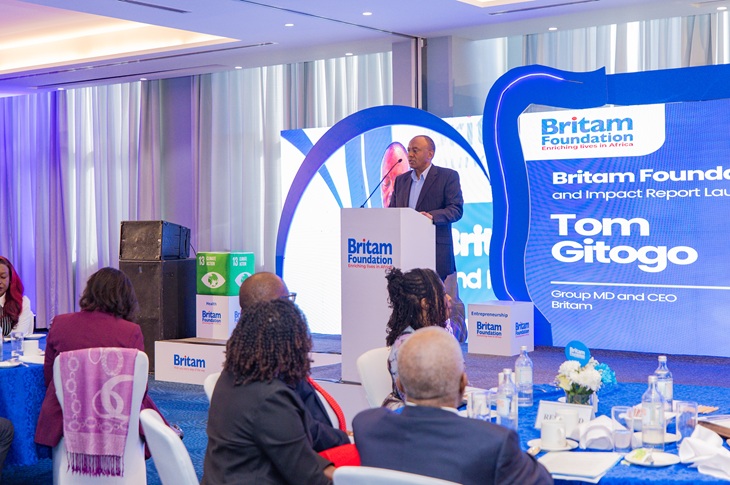
Britam Foundation Spearheads Climate Resilience and Reforestation in New Impact Report

Britam Foundation has unveiled its inaugural Impact Report, highlighting a series of strategic climate and community initiatives that have empowered over 92,000 lives across the region.
Since commencing operations in late 2024, the Foundation has successfully integrated environmental restoration with economic development, creating 1,358 jobs while addressing critical water and ecological crises in Kenya, Uganda, Tanzania, and Rwanda.
Central to the Foundation’s climate strategy is its flagship water programme, which has deployed solar-powered boreholes to 70 schools. These systems have proven vital in arid counties like Kitui and Kajiado, where traditional water sources are increasingly threatened by recurring droughts. By transitioning to solar energy, the Foundation has not only provided a reliable daily yield of 9,291 litres of water per borehole but also eliminated the carbon footprint and high operational costs associated with diesel-powered pumps.
Tom Gitogo, Britam Group Managing Director and CEO, emphasized that these initiatives are foundational to regional stability. “Water is not philanthropy, it is development infrastructure,” Gitogo stated. “Our investment in solar water projects reduces operational burdens on schools, channelling scarce resources back into teaching and learning, thereby strengthening the future workforce. This is a deliberate loop, the more resilient and educated the community, the more stable our markets become.”
The environmental pillar of the report details a massive reforestation effort in the Mt Elgon water tower, a critical ecosystem that currently sits below five percent forest cover. In partnership with the Jumbo Charge Trust, the Foundation has reforested more than 444 acres, planting 86,000 indigenous trees. This project serves as a dual response to Kenya’s climate and employment crises, engaging 105 local businesses and nurseries to supply seedlings and providing livelihoods for over 1,300 individuals in seed procurement and nursery operations.
These efforts come at a pivotal moment, as World Bank projections warn that climate change could push an additional 43 million people in Sub-Saharan Africa into poverty by 2030 without urgent adaptation. Domestically, Kenya continues to strive toward a 10 percent forest cover threshold to mitigate the impacts of devastating floods and prolonged dry spells.
The Foundation’s work also extends to maternal health through the Lea Salama programme, which has supported 305 uninsured mothers in Nairobi’s Kibera settlement. By combining community health networks with digital platforms, the programme achieved a 97 percent skilled delivery rate, significantly outpacing national averages and addressing the high mortality ratios found in underserved urban areas.
Dr. Peter Munga, Britam Foundation Board Chair, noted that the Foundation’s mission is rooted in the long-term health of society. “Our stability is intrinsically linked to the stability of the communities we serve,” Munga said. “By driving progress across our pillars of Health, Education, Environment, and Entrepreneurship, we ensure that Britam’s legacy is measured not only by our returns, but by the resilience we build into the very fabric of society.”
Catherine Karita, Director of the Britam Foundation, added that the success of the past year stems from an integrated approach to human and environmental well-being. “At Britam Foundation, we believe that true impact is measured not by intent, but by lives changed and futures secured,” she said. “Over the past year, our work has intentionally bridged our four pillars, recognizing that sustainable change happens when solutions address multiple dimensions of human wellbeing at once.”
The Foundation is funded through a structured model where Britam Holdings PLC commits one percent of its annual profit after tax to community investment. By aligning with Sustainable Development Goals (SDGs) for Clean Water, Climate Action, and Decent Work, the Foundation continues to embed social and environmental impact into the core of its financial planning.