
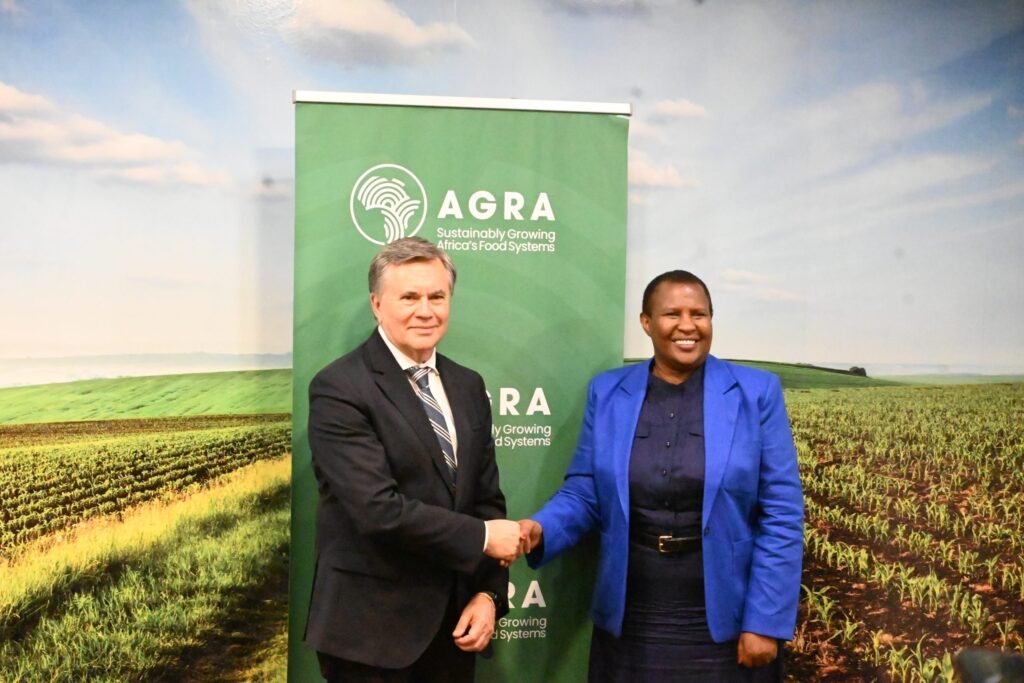
A Major Global Risk Ahead of Davos 2026 as AGRA Warns Hunger Is Being Overlooked

As global leaders prepare to convene at the World Economic Forum in Davos, AGRA has raised concern that hunger is being dangerously underplayed in global risk assessments, despite intensifying climate pressures, geopolitical disruptions and increasingly fragile food systems, especially in Africa.
In a statement released Thursday, AGRA noted that the World Economic Forum’s Global Risks Report 2026 does not list hunger among the top 10 global risks over either the short-term (two-year) or long-term (10-year) horizon. This omission comes at a time when climate shocks are accelerating, ecosystems are under strain and global supply chains remain vulnerable, threatening the foundations of food production across large parts of the world.
More than half of Africa’s population depends directly on nature for their livelihoods, highlighting the deep links between food security, ecosystem health and economic stability. Yet hunger does not feature prominently in the global risk rankings, which are dominated in the near term by geopolitical and geoeconomic tensions, misinformation, social polarisation, extreme weather and armed conflict. Over the longer term, environmental threats such as biodiversity loss, ecosystem collapse and natural resource shortages take precedence—still without explicit recognition of hunger as a core risk.
AGRA acknowledged the seriousness of the risks identified in the report but warned that hunger should not be treated as a secondary humanitarian issue.
“Hunger is not a niche concern. It is a compounding, destabilising risk multiplier,” AGRA said, noting that food insecurity fuels displacement, undermines political stability, deepens inequality and weakens human capital and productivity. “You cannot have strong economies without healthy ecosystems, and you cannot have healthy people without access to safe, affordable and nutritious food.”
Alice Ruhweza, President of AGRA, said the global community often reacts too late when hunger is framed as a downstream outcome rather than a frontline risk.
“When hunger is treated this way, the world responds only after livelihoods collapse, conflicts intensify and children’s nutrition and learning are permanently damaged,” Ruhweza said. “Food and nutrition security must be integral to the global risk management architecture.”
AGRA pointed to recent UN food security assessments showing that hunger is already widespread and worsening in Africa. An estimated 673 million people faced hunger globally in 2024, with Africa’s hunger prevalence exceeding 20 percent—affecting more than 307 million people. The trend is moving further away from the Sustainable Development Goal of Zero Hunger, even as Africa’s population is projected to reach 2.5 billion by 2050.
Scientific consensus indicates that climate change is already reducing food security through declining crop yields, pressure on livestock and fisheries, and rising food prices. These impacts are particularly severe for small-scale producers in Africa, underscoring the need to transform agriculture to achieve climate resilience.
AGRA emphasized that climate change and nature loss represent a single, interconnected crisis—and hunger is how that crisis reaches households. Degraded soils, water stress, biodiversity loss and rising temperatures directly threaten harvests, incomes and diets, while weakening resilience to droughts, floods and heat.
Meeting Africa’s future food needs, the organization said, will require climate- and nature-positive agricultural innovations that increase productivity while reducing pressure on land and ecosystems.
“Hunger doesn’t wait for the world to finish debating risk rankings,” Ruhweza said. “It grows quietly through depleted soils, failed rains, unaffordable diets and stunted children. Davos should be a turning point where global risk leadership reflects the reality facing farmers and families.”
Ahead of Davos 2026, AGRA is calling on governments, development banks, philanthropic partners, insurers and agrifood businesses to explicitly recognise hunger and malnutrition as first-order global risks. The organisation is urging investment in climate adaptation for smallholder farmers, including stress-tolerant seeds, climate services, insurance and localised extension systems.
AGRA also wants soil health and landscape restoration placed at the centre of food security strategies, alongside increased investment in infrastructure such as water management, storage, rural roads, energy access and efficient market systems.
The African Development Bank projects Africa’s food and agriculture market will reach USD 1 trillion by 2030, an opportunity AGRA says demonstrates the economic, social and environmental benefits of ending hunger.
“The roadmap is clear,” AGRA said. “The question is whether global leaders gathering in Davos will act with the urgency this moment demands.”