
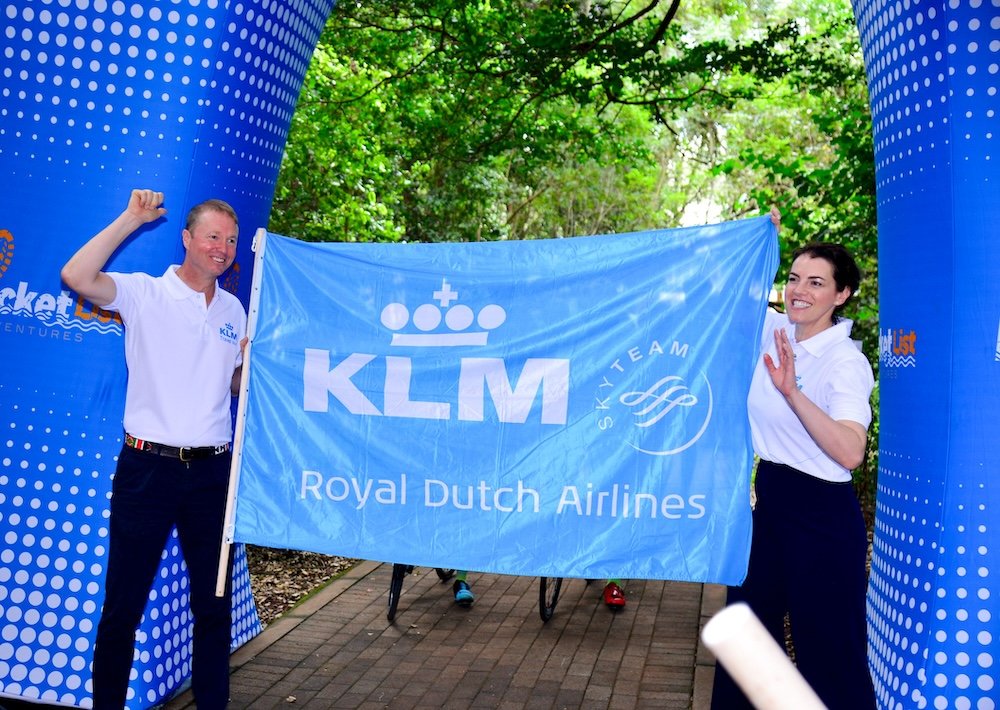
KLM Flags Off Nairobi–Lolldaiga Cycling Expedition to Champion Circular Sustainability and Aviation Decarbonisation

KLM Royal Dutch Airlines has flagged off a cycling expedition from Nairobi to the Lolldaiga Conservancy in central Kenya, marking a unique blend of community-driven environmental action and the airline’s long-term commitment to sustainable aviation.
The multi-day ride, covering more than 350 kilometres, aims to raise awareness on waste management and upcycling while supporting local communities. Along the route, cyclists will deliver recyclable sanitary pads to a girls’ school in Laikipia, a symbolic gesture tying grassroots solutions to broader climate goals. The event also coincides with KLM’s 106th anniversary celebration.
“Sustainability is not just about decarbonisation; it’s about being a fantastic employer and a good corporate citizen,” said Zita Schellekens, Senior Vice President for Group Sustainability at Air France-KLM, during the flag-off ceremony in Nairobi. “We want to be a company that staff enjoy working for and people enjoy flying with. Today’s ride is fun, meaningful, and a way for us to give back.”
While the expedition unfolds on land, its message extends to the skies. Waste transformation has become a key pillar in KLM’s sustainability strategy, with upcycled and waste-derived materials expected to play a major role in the future production of Sustainable Aviation Fuel (SAF). SAF emits up to 80% less lifecycle CO₂ than traditional jet fuel and is central to KLM’s target of reducing emissions per passenger kilometre by 30% by 2030, compared to 2019 levels.
The Nairobi–Lolldaiga ride also highlights the shared responsibility for climate action and the potential for local circular economy models. In East Africa, agricultural waste, used cooking oils, and organic residues offer promising raw materials for SAF production, an area KLM and its partners are actively exploring.
“We are honoring a part of KLM’s 106-year legacy while focusing on our future and the sustainability of our industry,” said Joris Holtus, Air France-KLM’s General Manager for East and Southern Africa, Nigeria, and Ghana. “Building a sustainable model means maintaining close, balanced relationships with the communities where we operate.”
The initiative forms part of The Aviation Challenge, a SkyTeam-led programme encouraging airlines to test and scale innovative sustainability solutions. KLM has previously piloted projects on optimised flight paths, onboard waste reduction, and real-time emissions monitoring. This year, the focus shifts toward integrating communities, supply chains, and operations into a holistic sustainability framework.
Earlier in the week, KLM and Kenya Airways convened a joint stakeholders’ workshop in Nairobi to develop a regional SAF action roadmap. The evolving framework will outline key milestones, investment priorities, and pilot projects in both Kenya and the Netherlands over the next decade.
The chosen route through central Kenya underscores the realities of climate change, with the region experiencing rising temperatures, erratic rainfall, and increasing strain on natural resources.
“I am confident that this expedition will have a significant impact,” said Kelvin Ndungu, one of the participating cyclists. “It shows that cycling is about more than being seen on the road — it’s about driving real change and making a difference in our communities.”