Ruto Hits Back at Trump’s Climate Remarks at UNGA

The 79th United Nations General Assembly (UNGA) in New York took a dramatic turn this week after U.S. President Donald Trump dismissed climate change as “the greatest con job ever perpetrated on the world.” The former president, who returned to office earlier this year, used his speech to cast doubt on decades of scientific consensus and to attack international climate agreements.
He accused the UN and global experts of misleading the world with false predictions and “bad reasons,” arguing that trillions had been wasted on renewable energy policies that he described as unreliable, expensive, and a drag on national economies.
Trump insisted that fossil fuels remain the most reliable path for economic growth and accused countries adopting aggressive green energy policies of undermining their own competitiveness. His comments were in line with the climate skepticism that defined his first presidency but struck a sharper tone, coming at a time when many nations are grappling with the escalating impacts of extreme weather events.
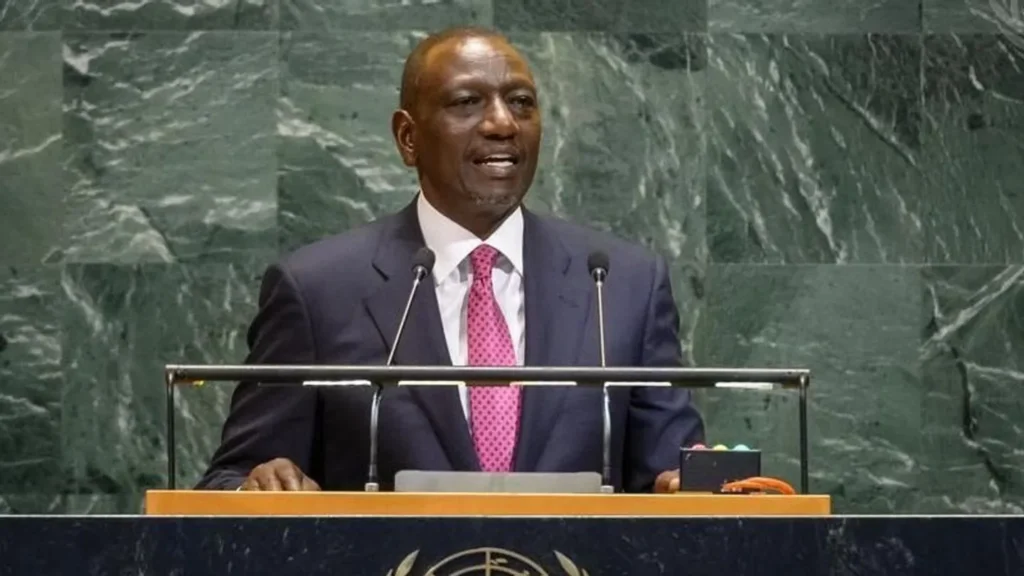
Kenya’s President William Ruto strongly rejected Trump’s claims, pointing out that the effects of climate change are already devastating millions of lives across Africa and beyond. In an interview with France 24 on the sidelines of UNGA, Ruto said no amount of rhetoric could change observable reality. “No matter how powerful you are, you cannot change reality. Climate change is real. Climate action is necessary. Facts are stubborn,” he said. He cited the rising frequency of floods, wildfires, and droughts as clear evidence that the crisis is unfolding in real time.
Ruto stressed that African nations are no longer approaching climate diplomacy from a position of dependency or charity. Instead, he said, the continent is advancing bankable projects and investment opportunities that can drive both resilience and economic growth. For Kenya, which has already made significant investments in renewable energy, climate action represents both a survival strategy and a pathway to prosperity. “We are not begging for charity. Africa is putting forward investment opportunities in energy, agriculture, and adaptation. The conversation must shift to viewing climate action as both urgent and economically viable,” he added.
The Kenyan leader also used the platform to call for reforms of international institutions, including the United Nations and global financial systems, warning that without change they risk losing credibility and relevance. According to Ruto, the governance structures of these institutions no longer reflect the realities of the modern world, leaving vulnerable countries without an equal voice in shaping solutions to shared challenges.
The sharp contrast between Trump’s dismissal of climate science and Ruto’s evidence-based appeal underscores a growing divide in global climate politics. For skeptics like Trump, climate action is framed as an economic burden, while for leaders of vulnerable nations it is seen as a matter of survival. Analysts warn that this divide threatens to slow international cooperation at a time when climate shocks are intensifying.
For Africa, the stakes are particularly high. The continent contributes less than four percent of global greenhouse gas emissions yet bears a disproportionate share of the consequences. Rising sea levels, erratic rainfall, and prolonged droughts are already disrupting agriculture, worsening food insecurity, and straining public health systems. Ruto’s intervention reflects the urgency felt across the continent: climate change is not a distant threat but a present reality demanding immediate and sustained action.