
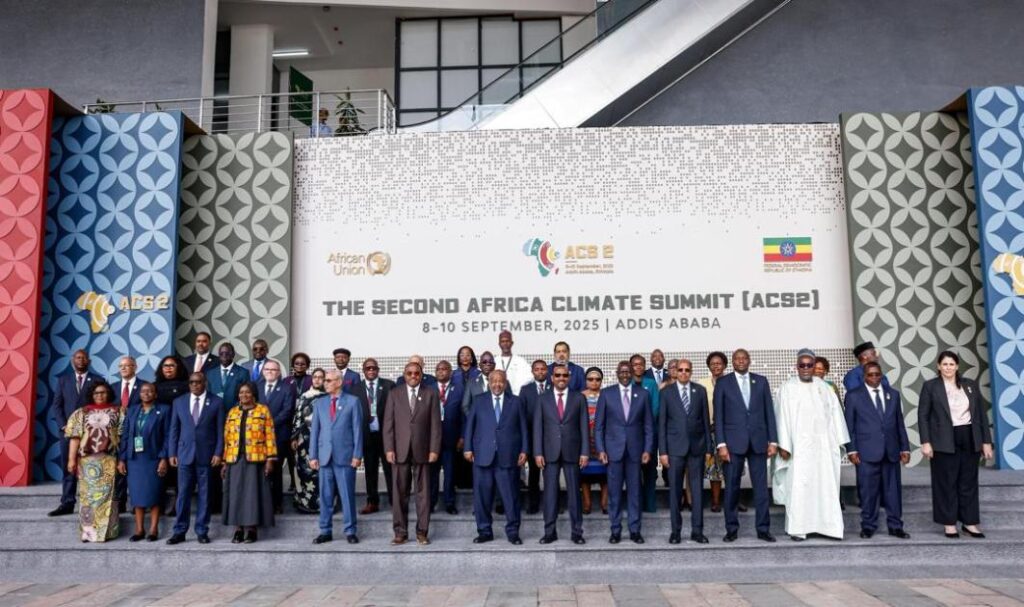
The Engine of a Green Future as Second Africa Climate Summit Ends in Addis as Leaders Position Africa

The second Africa Climate Summit (ACS2) took place in Addis Ababa, Ethiopia, from 8th to 10th September 2025, at the African Union Convention Centre. Held under the theme “Accelerating Global Climate Solutions: Financing for Africa’s Resilient and Green Development,” the summit underscored that Africa does not merely seek assistance—it demands investment, fairness, recognition, and leadership.
Ethiopia’s Prime Minister Abiy Ahmed opened the summit with a rallying call: Africa must no longer be framed as a victim in the climate narrative, but rather as a source of solutions. “Too often Africa’s story at climate summits begins with what we lack—finance, technology, time. Let’s begin instead with what we have,” he said, highlighting the continent’s greatest strength—its youth. In a symbolic act of commitment, leaders planted trees at the opening ceremony, each seedling representing a pledge to reshape Africa’s climate future.
For many, ACS2 was deeply personal. The impacts of climate change—rising seas, prolonged droughts, and devastating floods—were not abstract policy points but lived realities. Local activists and leaders spoke of destroyed harvests, lost livestock, displaced youth, and children missing school because heavy rains had washed away roads. These stories transformed formal negotiations into urgent discussions about families, livelihoods, and survival.
One of the summit’s biggest calls was to rethink climate finance. Instead of positioning Africa as perpetually dependent on aid, leaders demanded predictable, fair, and accessible investment driven by African priorities. Two key mechanisms were announced to mobilize US$50 billion annually for climate solutions: the African Climate Innovation Compact and the African Climate Facility. Leaders emphasized that adaptation—helping communities cope with climate impacts—must be given equal priority alongside mitigation—reducing emissions.
Yet ACS2 was not only about challenges. Stories of innovation and hope filled the conference halls. Young African entrepreneurs showcased solar-powered irrigation systems. Community leaders shared how restoring wetlands and forests had improved water retention. Engineers presented plans for regional electricity grids that could one day unite African countries through clean energy. International partnerships, such as CEPA and ENGAGE (with the European Union and Germany), highlighted how collaboration could accelerate renewable energy access and integration across the continent.
As the summit concluded on 10th September, there was cautious optimism. Declarations and pledges were ambitious, but the weight of expectation now rests on action. For communities that traveled hundreds of miles to tell their stories, the pressing questions linger: Will the pledged finance materialize? Will local voices shape decision-making? Will justice move beyond rhetoric?